Showing posts with label Arts. Show all posts

Saturday, 14 July 2012

Arts & Antiques Fair 2012 | A summer of Arts and Antiques in Halkidiki


Success has many faces and we were more than pleased to see many of them during those three days of Arts & Antiques Fair. Despite the fail offs of  the first-timer, our resolution to remain available for 12 hours (10.00 – 22.00) each day gave everyone the opportunity to visit us whenever he/she wanted, even though the preferable time for many of you turned out to be afternoon and the early evening.

The majority of the audience were they welcomed were foreigners, as we had expected and wished, due to our best intentions to show quality art and antiques in a more scarce in the city of Thessaloniki public. However, it would be unfair not to thank the Greek visitors who came along to see us. A big thank you is also in place for Nikos & Eleni Grigoriades, owners of G Hotels and the luxurious resort “Athos Palace” in Kallithea which accommodated the Arts & Antiques Fair, as well as the hotel staff who immediately responded to our every request.

The process was arduous but enjoyable. Useful and constructive. And there would be none of this if we had a good team, a professional company and perfect partners.

In addition, we have attracted wide attention from the media, both nationally and locally (over 50 publications in newspapers and printed media in general, hosting in radio and television broadcasts, etc.).

The Arts & Antiques Fair is a newfangled institution that aspire to expand and develop in the coming years. Further and more interesting is that we intend to expand our business ecosystem to welcome everyone to this who will want to work through this crisis, rather than trying to salvage what remained from the market of the past, but building together a new market and our future. 


-Stavros Muronides & Paris Kapralos


Watch the slideshow of the "Arts & Antiques Fair 2012"


Friday, 8 June 2012

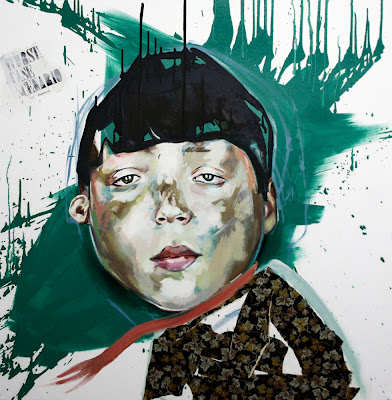
Faces of Art | Emilia Xanthopoulou


Emilia Xanthopoulou was born in 1983 in Thessaloniki. She studied at the School of Fine Arts of Thessaloniki (2003-2008) and extended her studies for a year at the School of Fine Arts in Madrid. Subsequently she undertook graduate studies at Central Saint Martins College of London (2009-2010) with Joanna Greenhill, where she was awarded the Mishcon De Reya Art Prize.. 


«I think when the simple painting really becomes Art, like any Art, fosters knowledge and creates conditions for new horizons. Observing the shape, color, form, light and shadow, I am constantly trying  to broaden my own horizons, and, within my skills, to actually produce Art. When I paint I try to fathom the essential, which is the utopian image of the artist on how the world should actually be. I am aware that there are those who would criticize me on this particular obsession. But I am interested to see and learn from my art, to communicate through it and rather be able to provide for the viewer of my works (on the latter I have no obsessions). Today knowledge of painting has been disgraced. Nowadays anyone can make art our of trash, roses, whatever else... But as someone claimed "so make sure you can use your magic wand to transform trash into the finest fillet, it is advisable to experiment on your own and not on the unsuspected customers of the restaurant." Finally, the confusion of values ​​that characterizes people in our times cannot affect the art itself; maybe the opposite happens, ie, the confusion of values that exist in art itself, cannot possibly affect the people of today».

Tuesday, 5 June 2012

The art discource of Fotini Hamidieli -an interview with the artist

FOTINI HAMIDIELI is an artist of rare breed in our era; one that assimilate all and every step of her existence into a new form, though keep walking at the same path she has chosen. Her strong personal style combined with a self – referential context within her art, makes her work distinct. Through our co-operation in Myrό Gallery we did not just meet a great artist, but a great lady as well, having the chance to discus on various subjects and aspects of the artistic experience. This interview was then set up, concluding our discussions and giving birth to others.


Interview to Paris Kapralos
- How did your journey in art begin?
My stay in New York and my teenage years was a determining factor in my choice to deal both with art as well as to find my place in it. I was fortunate in visiting great exhibitions, like one of Cezanne, organized by the Museum of Modern Art in New York when I was 16 years old, and a little later a retrospective exhibition of prints by Goya, another with drawings and sculptures of Giacometti... These were the initial experiences that triggered me to seek my position for many years I tried to find where I belong, a procedure that helped my first attempt to assimilate foreign environment, to feel that "I belong. I moved to America at the age of 12 – 13 and that's something that marks you for life at that age..


What's the focus in your artworks and how they have shifted during your life?
My work is mainly man-centered and turns around human figure. I have also created some landscape works, due to a personal requirement that I had to work the human figure in the presence of a natural model, a condition I was not able to fullfill at all times. On the other hand, the landscape was lways there for me, so, I did many landscaped lacking a human model. Then came a period that I worked intensely with portraits as well as with abstraction. However, when you re very young abstraction is a bit difficult style to manage; as a matter of fact its an extremely demanding style that requires experience and a maturity that can not be found at an early age. The truth is that I do not wish to have a specific goal when painting. I seek for no direction apart from that the work itself as it develops can provide and I prefer not to rationalize.


- An element ever present in your works is very distinct sketching...
There was a period that I had abandoned sketching, though it still was significant within my works in a substrate layer. En route I re-discovered it through crayons and charcoal and the vigor of the simple line; I begun utilizing the sketch once again. I wondered “how much can the sketch be developed? I how many things can I do with it?” Through the process you find out things...
.


- So determinant in your new series of works is not the way, namely the fact that the project is more intense and "hard"....
My designs may have a specific image and figure, but often when I create my paintings thinking about masses, concentrated forms and existence contrasts: the mass of white paper and through the mass to arise or emerge figures. You can see for example "black" from my new projects included in the last report in my Myrό gallery, within which a mass of lines through which flow into faces and forms is illustrated clearly. In those works the feeling is not only cleared, its appearing in a profound manner. When painting I had a definite image in my mind. I started to paint a smudge, somewhat inevitably, automatically and spontaneously. I saw the smudge like an explosion went up, stretched. The existence of the head on top of the mass, cut off from a complete figure was a shocking episode for me.
.


-From the viewer's point of view, your art till very recently seemed to belong to the figurative area; only recently abstract elements have are found in your work, seemingly with a renewed perspective... Truth is I'm somewhat feared of abstraction. When I younger there was a period that the only thing I was working on was abstraction. Although I started very well, the ending was not good. Very soon dried up, because when you are young you do not have much to say in this way. I think you have to have very good foundations firmly inside you to do abstraction. All these happened at my 22. Since then there are times I attempt to go back to abstraction not to forward towards iit, bbut carefully, little step each time; I must feel assured I can manage well. Abstaction is not just aligned lines, impressive colours and patterns: it requires comprehension, structure and maturity. Otherwise it feels empty.


-Are there people with a key role in your route?
The most significant thing that really marked me was the death of my sister and not a meeting with someone. Since then, painting has been a mean of communication and continuing relationship with my sister, as somehow already constitutes an alternative way to communicate with my mother who is currently not in a good condition. Actually, I think what turned me to painting was my attempt to communicate.
.
 

-What was the part that leaving for the States played in the development of your special artistic sight? 
I completed my studies in a highly innovative school. Our training is not based on the acquisition of knowledge, but experience did not emphasize the refinement of a given mode and route learning. However the way we were taught, was extremely free, open-minded and certainly effective. We had the chance to study sketch with models as much as maybe no other school of art worldwide. We had so many options to explore, we were assisted to choose the path that suits us really by the end of the day, it was possible that we experiment with a lot, without having anyone telling us that “this the right thing to do” and something else is not. Every artist must have strong foundations to build on, but the way you acquire knowledge is never unique, in the same way there is no single road to the truth for everyone!

-Tell us about the times you've worked together with Dinos Christianopoulos....
The first time I took part in an exhibition was in 1982, at “Mikri Pinakothiki Diagonios”, which belonged to Dinos Christianopoulos. It was a lifetime experience for me, not only because it was the first time to exhibit but moreover because of the co-operation with Christianopoulos himself, and many other artists, writers, poets, musicians, all the Christianopoulos' personal circle who had embraced his attempt to bring a new kind of cultural style to the city of Thessaloniki. Great help, but grave, rigorous severity. Every fortnight I would get him some of my newest paintings to take a look; he would criticize them with sternness, no matter who would be present. He used to put it with an elegant humorous spice everytime he did that, so that the aftereffect was not bitter: This should be the perfect ornament for sheep; it certainly will become them”, “Oh that would be a marvelous addition for my sheepfold in the village”... Comments like that could be outspoken in front of anyone!


-Your path is somehow double, after working for many years in education. How consistent is the one object to the other?
Perfectly harmonious and excellent to each other I would say.
I work in education for 20 years. I work at the school and also organize workshops for children. My path is not merely parallel but complementary. You can experiment with another way I can express myself more, and, ultimately, learn and gain a lot from my interaction with the children. It's amazing to me that breathe through these children. Its something to do with their carelessness that renews me, while creativity and their joy in being able to create things can “re-charge” the artist in a unique manner. You feel that you really communicate with someone who understands and feels deeply the way you do whhen creating your works. The school and the teaching used to frighten me for very long time before I make up my mind and start teaching. I thought I would run out soon, and I avoided it for several years; I was just teaching English for 11 years before I try teaching art...


Monday, 23 April 2012

Nikolaos Gyzis, paintings that rejoice life 111 after the demise of their creator

NOT many things seem so unnatural to me as the claim that the classic greek painter Nikolaos Gyzis was the academic standard of his times, unless accompanied with the clarification of what was consider academic in his times! In this article I would like to present to our readers one of the most dynamic personalities in art of all eras in Greece, an excellent man and artist exemplar for the turn of the 20th century, for whom books have been written yet essential elements of his personality and paintings are not stressed, or known to the non specialized public, and whose contribution changed everything in Greek Art.
By Paris Kapralos

Nikolaos Gyzis, an extremely dynamic, cordial personality and a truly natural talent, was able to assimilate and blend in a rare manner all the knowledge and experience he came in contact with, and to transcribe it in a way that contributed to the progress of Greek art at his times, as very few other visual artists have accomplished. His works retain their strength and their emotional charge, even 111 years after his death. His works do not remain merely "immortal", a term reserved for other major painters in the arts history; they often remain alive.

Born in a poor family of carpenters Onoufrios Gyzis Gyzis and Margaret, nee Psaltis, in a little village named “Sklavochori” on the island of Tinos the 1st of March 1842, he followed the family to resettlement in Athens in 1850 and attended the so called "School of Fine Arts" (1854 - 1864), with teachers Agathaggelos Triantafyllou, Ludwig Thiersch and Filippos Margaritis, replaced in 1855 -after his retirement- by Nikiforos Lytras, who became close friends with the young Gyzis. It is said that it was Lytras who urged Gyzis to continue with his studies at the  Royal Academy of Fine Arts in Munich from from June 1865. Before this was possible many things had to be settled first. The young artist was deprived of a fortune that would allow him to move abroad, if it wasn't for a charity of the of the church to assist him encouraged by another man that foresaw the talent of the young artist, the art fanatic Nikolaos Nazos, who also added his funding to this of the church to support Gyzis.

His first teachers in Munich were Ansouts Hermann (Hermann Anschütz) and Alexander Wagner (Alexander Wagner), while in 1868 -again with the encouragement of Lytras -was admitted to the laboratory of Karl von Piloty, a famous teacher with a significant personal focus on multifaceted historical paintings. Nevertheless Piloty had the reputation of an excellent teacher that didn't force this students to replicate what he did, but to perfect their design and enrich colour ranges, otherwise leaving room for personal expression and development to them


Actually, the marathon of recognition begins on 1870 for Gyzis, with so many awards as many nominations and a glimpse of financial independence from his donors and protectors. In 1872 he returns to Greece temporarily, setting up his atelier in the centre of Athens, where he remained nearly a year and a half strolling around the city and travelling around the country very often in search fro the Greek representative types of face, body, stature. Next, he travels to Asia Minor along with Lytras in search of similar studies, collecting important material. In that period discounted original designs with extreme stunts of Anatolia; all of these paintings are rare in light, colour, and realistic expression. Then he travels to Tinos and Megara -where he paints a series of projects, and for a few months he resides in Smyrni (Izmir). Disappointed by the prevailing conditions in Greece in May 1874 he departs from Athens, having  a heavy load of experience and pictures in his artistic baggage, and returned to Munich, where he lived almost continuously until the end of his life. In 1876, he travelled along with Nikiforos Lytras in Paris, and one year later married Artemis  Nazou, daughter of his patron, who gave birth to their four daughters. The course worthy of going to Germany, participates in the International Art Exhibition in Munich in 1879 not only as a painter but also as a member of the jury, and in 1880 was named an honorary member of the Academy of Fine Arts in Munich and in 1888 was elected professor at same institution. In Germany hailed as few artists of his time. 1895, last visited Greece. In 1898 the German government buys many of his paintings to the National Gallery, and the artist working on a painting entitled "The Apotheosis of Bavaria," so states in a letter "I would love to create the apotheosis of Greece, but I cannot carry this burden alone, since most people who claim they work for its apotheosis, they really strip Greece bare”.

Contracting leukemia he died in Munich on 1901. It is said that an unfinished letter was recovered after his death, concluding at the phrase “Well, let us never give up hope and chase happiness in every aspect of our lives”. He was buried in the cemetery of Nord-fidhof in Munich, and as an homage the sculptor Heinrich Waderé crafted the grave's monument, his friend and well-known German painter Franzvon Lenbach  sketched him on the deathbed, while Kostis Palamas, the national poet of Greece wrote the poem "In the tomb of Nicholas Gyzis"..


On his works
Nikolaos Gyzis is one of the most important representatives of the academic realism of the late 19th century, belonging, in the somewhat more conservative than he ever was, art scene of the "Munich School". Even if the higher of the German critics of the era called him “more german than the Germans”, his paintings convey the colours, smells and images of the East and Greece inj a manner no other painter portrayed with such vividness and completeness. In the case of Nikolaos Gyzis, even the most suspicious the art lover will understand that the term "academic realism" is -so to speak- incompatible in the manic commitment to a rational commitment to the project accuracy and rigor of chiaroscuro, since the word "academic" nowadays is poorly understood as similar to the word “classic” in form and style: his works are all alive, have depth found to few artists of his time and even after him, so intense, that few has managed to combine realism and idealism with symbolist elements in an excellent manner. Let “academic” in the case of Gyzis remind us of the ancient Athens Academy, when the word really meant eclectic and not simply classical with a sip of conservatism to taste!


The work of Nikolaos Gizis divided into three periods: the "German"-which covers the first seven years of flight in Germany, the "idealist," starting from March 1876, when the author first tackled the great allegorical work, the panel "Art and spirits," and, ten years later, in 1886 started what many call the "Neo-idealistic" Gizis period, when the painter studies the life and spirit of the ancient and subordinate to a Platonic philosophical approach and the quest for eternal beauty. Furthermore, from 1890 onwards he is sketching / designing series of signs and posters at the relevant orders, which was also recognized as both art and a boost in graphic arts. Religious person, with strong existential quests, turned at the end of the path to metaphysical and allegorical scenes. The dominant element of his so-called "religious" is the struggle of good over evil and the final victory of Good.